
Category: NRI Finance

  • The ₹2 Coin That Bought an iPhone: What Indian Comedy Tells Us About Money

    The ₹2 Coin That Bought an iPhone: What Indian Comedy Tells Us About Money

    The Sketch That Broke the Internet (or at Least Indian YouTube)

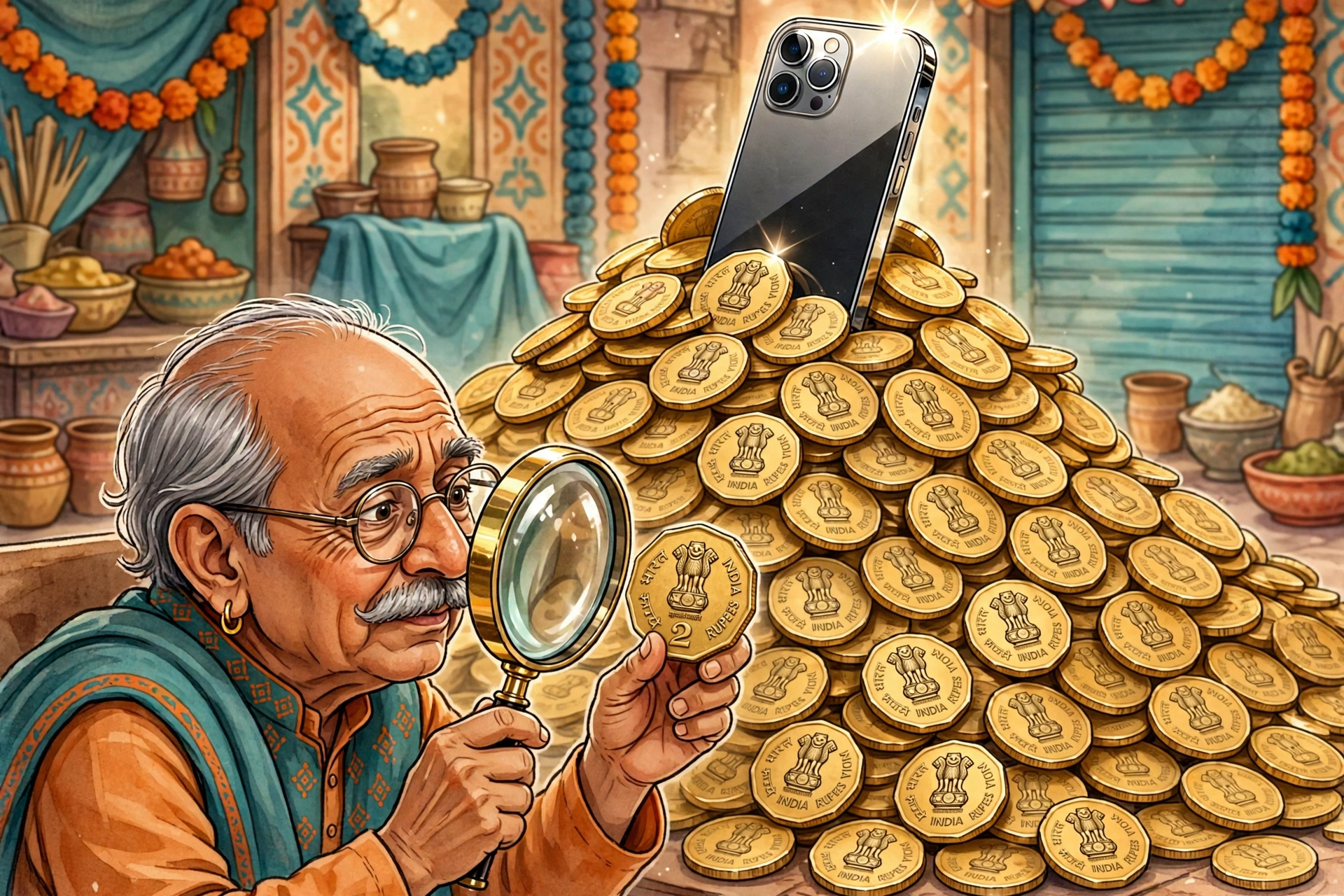
    Thirty-five million views. Six hundred ninety-four thousand likes. For a short comedy sketch with a premise a five-year-old would reject as unrealistic: buying an iPhone 18 Pro Max with ₹2 coins.

    It is, on its face, absurd. An iPhone costs over a lakh rupees. You would need roughly fifty thousand ₹2 coins. They would weigh about 250 kilograms. You would need a truck, not a wallet.

    And yet 35 million people watched it. They laughed. They shared it. They tagged their cousins.

    Why does this specific joke land so hard in India? The answer tells you more about Indian money psychology than any economics textbook. And buried inside the laughter is a question worth real money: are any of those old coins in your grandmother’s steel almirah actually worth something?

    Let us start with the funny part. Then we will get to the part that could pay for your next flight to India.

    The Uncle Who Checks Every Coin

    Every Indian family has one. The uncle who, upon receiving change at a shop, holds each coin up to the light like a jeweler appraising a diamond. Who has opinions about which year’s ₹5 coin “feels heavier.” Who once read a WhatsApp forward claiming a particular ₹1 coin was worth ₹5 lakh and has been checking ever since.

    This uncle is not crazy. He is the product of a very specific national experience with money.

    Consider what the average Indian over forty has lived through. In 2016, the government announced on live television, with four hours’ notice, that all ₹500 and ₹1,000 notes would cease to be legal tender by midnight. People stood in bank queues for weeks. Weddings were postponed because families could not access cash. The notes you had in your wallet that morning were, by evening, colorful paper.

    Now: was demonetization good policy or bad? Economists are still arguing, and this is not that article. But the psychological effect is not debatable. An entire nation learned, in one evening, that money is a story the government tells, and the government can change the story whenever it wants.

    Coins, though. Coins survived. Nobody demonetized the ₹2 coin. And so the coin became, in the Indian imagination, the honest money. The money that cannot be cancelled by a press conference. The sketch about buying an iPhone with ₹2 coins is funny precisely because it inverts the trauma: what if the smallest, most ignored denomination turned out to be the most powerful?

    The WhatsApp Forward Economy

    If you are Indian and over thirty, you have received this forward. It arrives from a relative, usually with several exclamation marks:

    “RARE ₹1 COIN FROM 1985 WORTH ₹5 LAKH!!! CHECK YOUR OLD COINS!!!”

    Below it: a blurry photo of a coin. Sometimes the photo is of a completely different coin than the one described. Nobody checks. The forward travels through seventeen family groups before lunch.

    Here is the thing: the forward is not entirely wrong. It is wrong the way a stopped clock is right twice a day. Most old ₹1 coins are worth exactly ₹1. But a tiny number of them (specific minting years, mint marks, or errors) genuinely are worth lakhs.

    The WhatsApp forward economy runs on a one percent truth stretched over ninety-nine percent fantasy. That one percent is real, though: the difference between the ₹1 coin in your pocket and the ₹1 coin worth ₹1.5 lakh is knowledge most people do not have.

    Which Old Indian Coins Are Actually Worth Money

    Forwards aside, here is what Indian collectors and auction houses actually pay for:

    The British India Coins (Pre-1947)

    This is where the serious money lives. Coins minted under British rule, especially in silver, are the blue-chip stocks of Indian numismatics.

    The most famous is the 1911 one-rupee coin, sometimes called the “pig coin” because a minting quirk made the elephant on the reverse look porcine. In uncirculated condition, these have sold for ₹3 lakh to ₹15 lakh at auction. The value comes from a specific variety: the 1911 rupee without a dot below the date, a tiny minting variation that most people would never notice.

    Other British India coins with real market value include the 1939 one-rupee coin (wartime silver issue), the 1862 Victoria rupee in rare varieties, and proof sets from the Bombay and Calcutta mints. Silver content gives these a floor; collector demand pushes the ceiling far higher.

    Early Republic Coins (1950s to 1970s)

    After independence, India minted coins in cupronickel featuring the Ashoka Lion Capital. Most are common. But low-mintage years and proof-only issues are genuinely scarce.

    The 1970 proof one-rupee coin from the Mumbai mint has traded around ₹2.25 lakh. The 1985 Kolkata mint circulation rupee, an ordinary-looking coin, has sold for over ₹1.3 lakh because of an unusually small mintage that year. These are the coins most likely to be hiding in that steel almirah: ordinary-looking, easily overlooked, genuinely valuable.

    Error Coins (Any Era)

    Minting mistakes are the lottery tickets of coin collecting. Off-center strikes, double dies, wrong-planchet strikes, rotated dies: these turn a ₹5 coin into something worth ₹50,000 or more.

    A wrong-planchet error (a coin struck on another denomination’s blank) can fetch ₹1 lakh to ₹3 lakh. Major mismatched-die errors have crossed ₹3 lakh. The catch: you need to know what you are looking at. Most “error coins” people find are just damaged coins, worth nothing extra.

    Commemorative Coins

    India has issued commemorative coins for events and personalities: the 100-rupee Indira Gandhi coin, the 150-rupee Tagore coin, the 500-rupee Gandhi Smriti coin. Uncirculated proof sets trade between ₹25,000 and ₹1 lakh. Not retirement money, but real value sitting in drawers across the country.

    What Is NOT Worth Money

    Let us be blunt, because the forwards will not be: your regular stainless steel ₹1, ₹2, or ₹5 coins from recent years are worth face value. Full stop. The ₹2 coin from the comedy sketch, the one that supposedly buys an iPhone, is worth ₹2. The joke is funny because it is impossible.

    Modern Indian circulation coins are minted in the hundreds of millions. Scarcity is what creates value, and there is nothing scarce about them. If someone on Facebook Marketplace offers to buy your 2019 ₹5 coin for ₹50,000, that person is running a scam, not a coin dealership.

    How to Check What You Have

    So your grandmother does have that almirah. Or your parents have a box. Or you do. Here is how to evaluate what is inside without falling for the forwards:

    Step 1: Sort by year. Anything pre-1980 deserves a closer look. Anything pre-1947 deserves a very close look. Modern stainless steel coins can go back in the jar.

    Step 2: Check the mint mark. Below the year: a small dot means Noida, a diamond means Mumbai, a star means Hyderabad, no mark means Kolkata. Certain mint-year combinations are scarcer than others, and missing or defective mint marks can themselves indicate a valuable error.

    Step 3: Look at the metal. If it is heavy for its size with a silvery ring when tapped, it might be silver or cupronickel rather than stainless steel. That alone does not make it valuable, but it puts it in the category worth researching.

    Step 4: Check for errors. Is the design off-center? Is there doubling visible in the lettering? Does one side look like it belongs to a different coin? Photograph anything unusual and compare against known error types before getting excited.

    Step 5: Get a real appraisal. Do not trust the WhatsApp forward. Do not trust the Facebook buyer who DMs you within minutes of posting. Legitimate options: auction houses like Marudhar Arts and Todywalla Auctions, the major coin exhibitions in Mumbai and Chennai, and certified dealers affiliated with the Indian Coin Society. For high-value pieces, international grading services like NGC or PCGS will authenticate and grade the coin, which dramatically increases buyer confidence and sale price.

    The NRI Angle: The Almirah Arbitrage

    Here is where it gets interesting for the NRI reader.

    Millions of NRI families live this exact situation: parents or grandparents in India sitting on boxes of old coins, nobody knowing what is valuable, and you, reading this from New Jersey or Seattle, the one most likely to actually research it.

    There is a genuine, small-scale arbitrage here. Not “get rich” arbitrage. “Pay for the Diwali flight” arbitrage. A single 1985 Kolkata rupee in good condition, sitting in a steel box in Pune, is worth more than a round-trip ticket.

    The play: next time you visit, spend an afternoon with the coin box. Sort by the steps above. Photograph anything pre-1980. Send the photos to a reputable dealer for a preliminary opinion before you fly home. If something looks promising, carry it back properly (legalities below) or consign it to an Indian auction house.

    The Legal Fine Print (Because This Is India)

    Coin trading in India has some real boundaries:

    Most old coins are legal to buy and sell freely. The restrictions kick in for ancient coins: items over 100 years old with archaeological significance may require permissions under the Antiquities and Art Treasures Act. You cannot export notified antiquities without a license. In practice, this affects Mughal-era and earlier pieces, not your grandfather’s 1970s rupees.

    For NRIs specifically: carrying old coins out of India in personal baggage for a legitimate collection is generally fine for ordinary numismatic items. For anything potentially qualifying as an antiquity, check with the Archaeological Survey of India before you pack it. When in doubt, sell through an Indian auction house and repatriate the proceeds through normal banking channels, which avoids the question entirely.

    This is not legal advice. For high-value pieces, talk to a professional. But for the overwhelming majority of what is sitting in family almirahs, the legal situation is straightforward: it is yours, you can sell it.

    Why the Sketch Got 35 Million Views

    Let us come back to where we started. A comedian pretends to buy an iPhone with ₹2 coins. Thirty-five million people watch.

    It works because it touches three live wires in the Indian psyche at once. First, the fantasy of hidden value: the deep, almost religious belief that something worthless-looking might secretly be precious. This is the same belief that powers the WhatsApp forwards, the uncle checking mint marks, the grandmother who will not throw away a single coin.

    Second, the demonetization scar. A nation that watched its currency die on live television has a complicated relationship with the idea of what money is “really” worth. The sketch is, underneath the slapstick, a revenge fantasy: the little coin, the one nobody demonetized, the one the government forgot about, turns out to be the most powerful money of all.

    Third, and simplest: it is just funny. The image of someone solemnly counting out fifty thousand coins at an Apple store is objectively hilarious. Comedy does not always need a thesis. Sometimes a truck full of ₹2 coins is just a truck full of ₹2 coins.

    But the best comedy has a thesis anyway, whether the comedian intended it or not. This one does. It is about what Indians believe about money: that value hides in unexpected places, that the official story is not the whole story, and that the humble ₹2 coin, overlooked by everyone, might just be the most honest money in the country.

    Now go check the almirah. You probably will not find ₹15 lakh. But you might find something worth a very nice dinner. And you will definitely find a story.


    Smarter money moves, with a sense of humor

    One email a week on NRI money, investing, and the cultural chaos in between. Funny first, useful always.

    Disclosure: IndiaPay may earn a commission from links on this page.
  • Before Apps: How NRIs Sent Money Home in the 1990s

    Before Apps: How NRIs Sent Money Home in the 1990s

    The Three-Week Wait

    In 1994, if you lived in New Jersey and wanted to send $500 to your parents in Kochi, here is what you did:

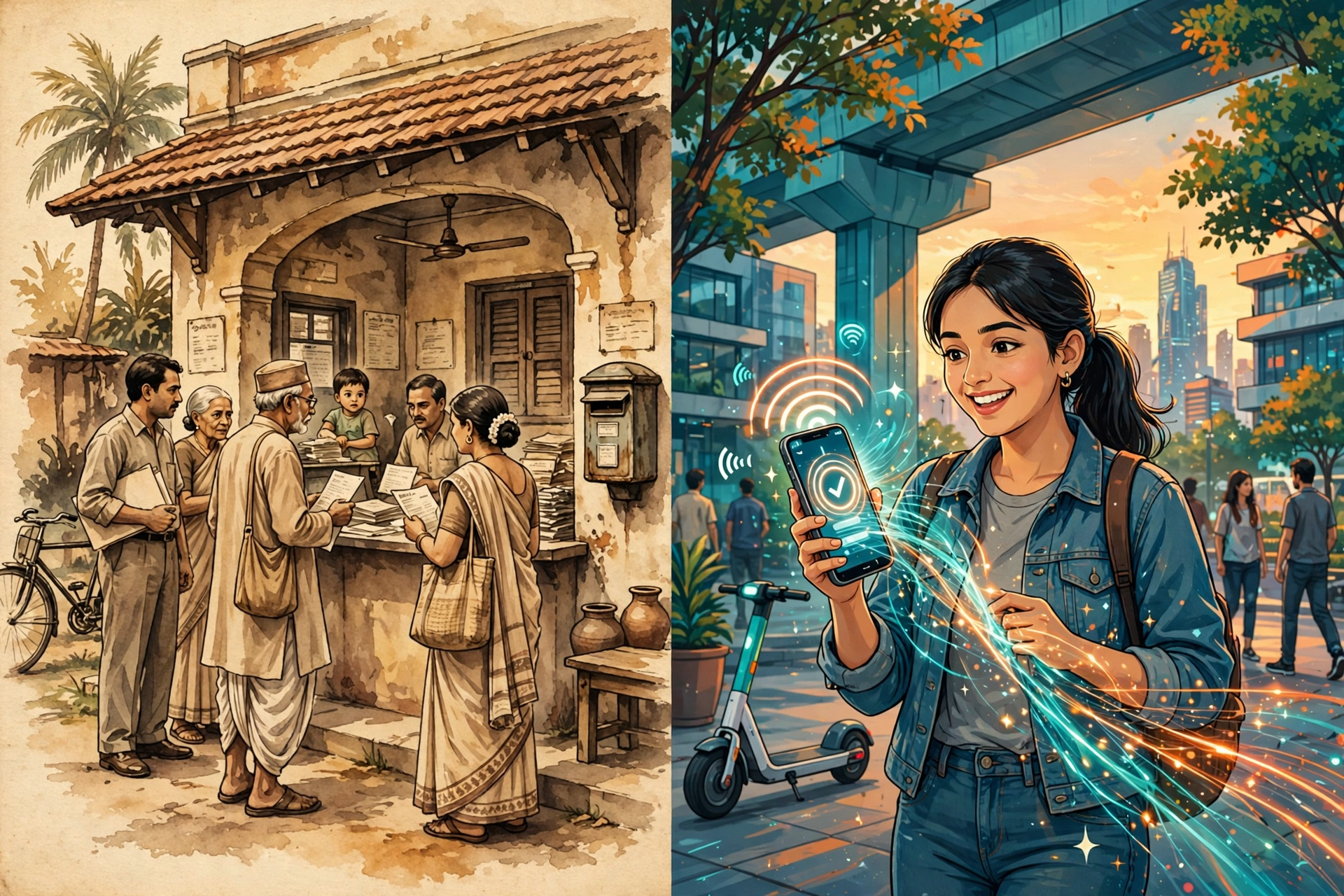
    You went to your bank. You filled out a paper form. You paid a fee that nobody could quite explain. The bank issued a demand draft, a physical piece of paper promising payment, which you mailed to India by international post. Your parents received it in two to three weeks, took it to their bank, and waited another week for it to clear.

    Total elapsed time: roughly a month. Total cost: somewhere between 5% and 10% once you added up the fees, the terrible exchange rate, and the postage. Total transparency: zero. For most of that month, your $500 existed only as a rumor.

    This was not the backward option. This was the normal option.

    The Menu of Bad Options

    The 1990s NRI had roughly four ways to move money, and each was bad in its own special way:

    Method How it worked Speed Cost The catch
    Demand draft Bank-issued paper draft, mailed internationally 3-5 weeks door to door 5-10% all-in Could be lost, stolen, or delayed by the postal service of two countries
    Telegraphic transfer (TT) Bank-to-bank wire via SWIFT/telex 3-7 days $25-45 flat fee + 2-4% rate markup Only worth it for large amounts; paperwork at both ends
    Carried cash The uncle with dollars in his socks Next flight home 0% (plus risk) Customs limits, theft risk, and the exchange happened at whatever rate the local money changer offered
    Hawala Trust-based informal network Hours to days 1-2% Illegal in most jurisdictions; no recourse if the operator vanished

    Read that table again. The illegal option was the fastest and cheapest. That tells you everything about how badly the formal system served migrants in the 1990s.

    Why It Was So Bad: The 1991 Context

    To understand 1990s remittances, you have to understand 1991. India went through a balance-of-payments crisis so severe that the government airlifted 67 tonnes of gold to London as collateral for emergency loans. Foreign exchange reserves had fallen to roughly $1 billion, barely three weeks of imports.

    The reforms that followed gradually opened the capital account and made the rupee more flexible after 1993, but the plumbing of cross-border money movement stayed Victorian for another decade. As recently as 2003, 86% of all non-cash payments in India were still paper instruments: cheques, demand drafts, cash. Electronic payments were a rounding error.

    In 1990, India received just $2.38 billion in remittances and ranked 8th in the world. By 1995, it was number one at $6.2 billion. By 2000: $12.9 billion. By 2010: $53.5 billion. In FY25: $135.4 billion. The World Bank data shows India has topped the global remittance table for 23 of the 27 years since 1995.

    The money did not just grow. The pipes changed completely.

    The NRI Lens: What It Felt Like

    Ask any NRI who moved abroad before 2000, and the remittance stories come out like war stories.

    There is the story of the demand draft that arrived after the medical emergency it was meant to cover. The story of the telegraphic transfer where the bank “lost” the SWIFT message for eleven days. The story of timing a trip home around carrying the maximum legal cash, and the specific anxiety of the customs line at Mumbai airport.

    But there is also something the old-timers describe that the app generation does not have: the ritual weight of it. Sending money in 1995 was an event. You went to the bank. You stood in line. You filled out forms in triplicate. You called home to say “I sent it, it should reach by the end of the month.” The slowness created a ceremony around the act. Today’s instant transfer is efficient, but nobody calls home to announce a Wise transfer the way they announced a demand draft.

    Speed ate the ritual. Whether that is a loss or a liberation depends on how old you are.

    The India Lens: What the Family Experienced

    From the receiving side, the 1990s system had a peculiar feature: the delay was a budgeting tool. Families knew the money was coming “sometime next month,” and planned around the uncertainty. The arrival of the draft was an occasion. Neighbors knew. The bank manager knew.

    Compare that to today, when $500 lands via IMPS in four minutes and nobody marks the occasion. The emotional bandwidth of remittances has collapsed even as the financial bandwidth exploded. Your parents in 1995 felt each transfer. Your parents in 2026 get a push notification.

    The old system’s slowness also protected people from themselves. You could not panic-send money at 2 AM because the rupee moved. You could not check the rate twelve times a day. The friction was a feature, accidentally.

    The Great Inversion

    Now, the reframe on today’s fees:

    The global average cost of sending remittances is 6.36% (World Bank, Q3 2025), still more than double the UN’s 3% target. Banks charge nearly 15%. The fintech apps charge 1% or less. NRIs complain, rightly, that even 1% is too much.

    But the 1990s NRI paid 5 to 10% and waited a month. The hawala user paid 1 to 2% and broke the law. Today’s “expensive” legal option is cheaper than the 1990s illegal option, and it arrives in minutes.

    The real revolution was not speed. It was legitimacy at low cost. For the first time in history, an ordinary migrant can move money across the world cheaply, quickly, and entirely within the law. Every generation before this one had to choose two of the three.

    The Thought Provocation

    Nostalgia for the demand-draft era is misplaced, but it contains a real insight: friction made money meaningful. The month-long wait, the trip to the bank, the phone call announcing “I sent it”, these turned a financial transaction into an act of care with weight and ceremony.

    Today’s system optimized away the wait, the cost, and the ceremony all at once. The money moves perfectly. But something was lost when sending $2,000 home became no more momentous than ordering groceries. The apps solved the economics of remittances completely, and accidentally deleted the meaning of remittances.

    Maybe the next revolution in money movement will not be about making it faster or cheaper. Maybe it will be about making it matter again. The uncle with cash in his socks was inefficient, risky, and illegal. He was also, in some way the apps have not figured out, present.


    The NRI money playbook, one email a week

    Remittance tricks, NRE/NRO guides, tax deadlines, and investment rules for Indians abroad. Practical, numbers-first, no fluff.

    Financial disclaimer: This is a historical and educational piece, not financial advice. Sources: World Bank remittance data via The Hindu BusinessLine analysis (1990-2021 rankings); RBI payment system data (86% paper instruments in 2003); World Bank Q3 2025 remittance cost data (6.36% global average); Economic Survey of India 2025-26.

  • The H1B Worker’s First Paycheck: Where Does the Money Go?

    The H1B Worker’s First Paycheck: Where Does the Money Go?

    Month One

    Rohan landed in Seattle on a Tuesday in October. By Friday he had a Social Security number, a studio apartment with a mattress on the floor, and a job offer letter that said a number he had rehearsed saying out loud in the mirror: $135,000 a year.

    He did the math on the flight over. $135,000 divided by 12 is $11,250 a month. In rupees, at roughly 90 to the dollar, that was over Rs. 10 lakh. Per month. His father, a retired bank manager in Pune, had earned Rs. 85,000 a month at his peak.

    Rohan felt, for approximately six days, like the richest person he knew.

    The First Paycheck Arrives

    The direct deposit hit on the 15th: $7,842.

    Not $11,250. $7,842.

    Rohan stared at the pay stub the way you stare at a restaurant bill that has items you did not order. Federal income tax. State income tax (Washington has none, a fact he would later cite the way people cite scripture). Social Security. Medicare. Health insurance premium. 401(k) contribution, which someone in orientation had strongly suggested and he had accepted the way you accept a seatbelt on a plane.

    Nearly a third of the salary, gone before it touched his account. Nobody on the flight over had mentioned this part.

    The Rent Conversation

    The studio was $1,850 a month. Utilities, $140. A bus pass, $100. Groceries, which he optimistically budgeted at $300 and which came in at $480 because American vegetables are priced like they were flown in by private jet (some of them were).

    Phone plan: $45. Renter’s insurance: $18. The mattress fund: ongoing.

    Running total of non-negotiables: roughly $2,800. Remaining from the paycheck: about $5,000.

    Then his mother called.

    The Call

    It was not a demanding call. It was worse. It was a not-demanding call.

    “Beta, don’t worry about us, we are fine. Your father and I were just talking, the fixed deposit matured, we were thinking of renewing it. But don’t send anything, you just reached, settle down first.”

    Rohan, who had been waiting his entire adult life for the moment he could send money home, heard this as: send money home immediately.

    He opened his laptop and typed “send money to India” into Google.

    The Fee Education

    What followed was the classic NRI onboarding sequence, compressed into one evening:

    Step 1: The bank. His US bank would wire the money for $45 plus an exchange rate that was, he later learned, roughly 3% worse than the real rate. On $2,000, that was about $105 in total cost. He closed the tab.

    Step 2: The apps. Wise, Remitly, Xoom, each with a different definition of “free.” He learned the central lesson of remittances within an hour: the fee is not the price. The exchange rate is the price. A $0 fee with a bad rate costs more than a $7 fee with a good rate.

    Step 3: The account question. Where should the money land? His parents’ regular savings account? His own NRE account? He did not know what NRE meant yet. He would learn, the way everyone learns, from a slightly panicked phone call with a cousin who had been in the US for six years.

    He sent $2,000 through an app. It arrived the next morning. His mother called to say it came. She did not mention the amount. She mentioned that it came fast.

    Where the Money Actually Went

    Here is Rohan’s first full month, reconstructed:

    Amount Share of gross
    Gross monthly pay $11,250 100%
    Federal + payroll taxes ~$2,400 ~21%
    Health insurance + 401(k) ~$1,000 ~9%
    Take-home pay ~$7,850 ~70%
    Rent + utilities + basics ~$2,800 ~25%
    Transfer to India $2,000 ~18%
    Transfer fee + rate cost ~$12 ~0.1%
    Remaining (savings, life) ~$3,000 ~27%

    Of the $11,250 he “earned,” about $2,000 reached his parents. That is 18%. The single biggest destination of his salary was not his family, not his landlord, not his savings. It was taxes.

    This is the part nobody tells you at the visa interview.

    The NRI Lens: What Rohan Did Not Know Yet

    Rohan’s story is a composite, but every detail in it is true for thousands of new H1B workers each year. Indians receive about 71% of all US H-1B visas; the US sends over $100 billion a year in outbound remittances, a large share of it flowing to India: $135.4 billion in FY25, the most of any country on earth.

    What Rohan did not know in month one, and what every new arrival learns within a year:

    The transfer is the easy part. The hard part is everything around it: which account the money lands in (NRE vs NRO changes the tax treatment completely), whether the transfer is a gift or support (it matters for US gift tax thresholds), and what happens to the money after it arrives (sitting in a savings account at 3% vs an NRE fixed deposit at 7%).

    The fee is the smallest line item. Rohan spent an evening agonizing over a $12 transfer cost. He spent zero evenings thinking about the $2,400 in taxes, which is the actual story of his paycheck. The remittance industry has brilliantly convinced NRIs that the fee is the thing to optimize, while the tax code quietly takes twenty times more.

    The guilt is the real tax. No financial product addresses this, but it is the largest force in NRI money movement: the feeling that you should send more, the mother’s “don’t worry about us,” the mental accounting where every dollar spent on yourself in America is a dollar not sent to Pune. Rohan’s $2,000 was not a financial decision. It was an emotional one wearing a financial costume.

    The India Lens: What the Family Sees

    From Pune, the story looks completely different. Rohan’s parents do not see the pay stub. They see a son who earns “Rs. 10 lakh a month” and sends Rs. 1.8 lakh home. The math they do is simple: he keeps 80%.

    This asymmetry, the family seeing gross while the worker lives net, is the source of half the tension in NRI families. The parents are not wrong; they just have different numbers. The worker is not ungrateful; they just have different bills. Nobody lies. Everyone misunderstands.

    The families, meanwhile, have their own onboarding: learning that the money arrives via IMPS in minutes now (not the demand draft that took three weeks in the 1990s), learning not to ask “but the rate was better yesterday,” learning that “I will send it on the 1st” is a promise the US payroll system does not always keep.

    The Thought Provocation

    Rohan’s first paycheck teaches the lesson that no remittance comparison article can: sending money home is not a transaction. It is the moment an immigrant’s financial life splits in two.

    From that first transfer onward, Rohan does not have one financial life. He has two, running in parallel, in different currencies, under different tax codes, serving different obligations. The $12 fee is trivia. The real story is that he is now a person who earns in dollars, owes in dollars, saves in dollars, and loves in rupees.

    Every NRI knows this split. Nobody talks about it at parties. But it is the defining financial fact of the diaspora: you do not just move countries. You move money systems. And the first paycheck is when you find out how much of yourself you left in each one.


    The NRI money playbook, one email a week

    Remittance tricks, NRE/NRO guides, tax deadlines, and investment rules for Indians abroad. Practical, numbers-first, no fluff.

    Rohan is a composite character drawn from common H1B experiences; tax figures are illustrative for a single filer at this income level and vary by state and situation. Sources: Economic Survey of India 2025-26 (India $135.4B remittances FY25); IOM World Migration Report 2026 (US outbound remittances); USCIS H-1B data on Indian nationals’ share.