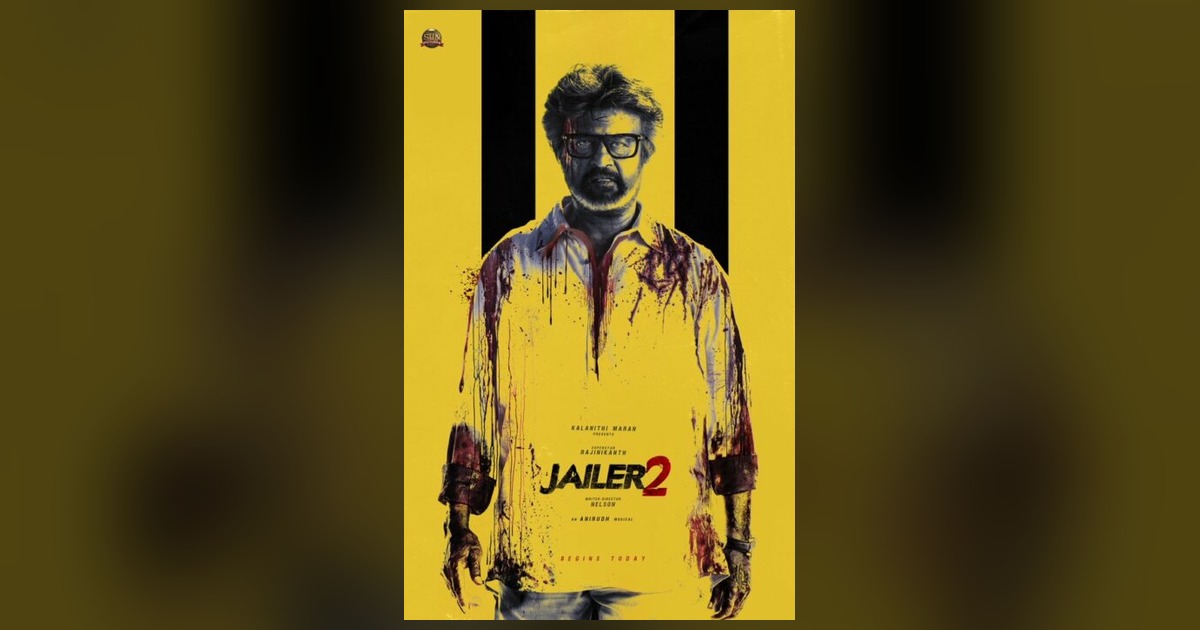
Jailer 2’s Money Trail: Where a Rajinikanth Tent-Pole’s Crores Actually Go
The Jailer 2 trailer dropped and pulled 15 million views in two days. Fifteen million. For a trailer. Rajinikanth is 75 years old and still moves numbers that make Hollywood marketing executives weep into their spreadsheets.
But here’s the question nobody asks while smashing the replay button: where does all that money actually go? A Rajini tent-pole isn’t just a movie — it’s a full-blown economic event with a money trail worth following. So let’s follow it.
Watch the Trailer
Jailer 2 Budget: What It Costs to Build a Tent-Pole
Big Tamil tent-poles like this reportedly run production budgets in the ₹200–250 crore range. That’s the all-in number, and it breaks down roughly like this:
The star’s paycheck. This is the elephant in every room. For a Rajinikanth film, the lead actor’s remuneration is widely reported to be the single largest line item — often estimated at ₹100+ crore for a project of this scale. Before a single frame is shot, a huge chunk of the budget is already spoken for. That’s not a criticism; it’s the business model. Rajini is the marketing.
Everyone else. The director (Nelson, coming off the first Jailer), the supporting cast, Anirudh’s music — these are significant but collectively smaller than the star line. Music directors of Anirudh’s stature command premium fees, and the supporting ensemble in a Jailer-scale film isn’t cheap.
Production. Sets, locations, action sequences, VFX, the army of technicians. A film mounted at this scale shoots across multiple schedules and locations. This is where the next big chunk goes.
Marketing and release. Prints, advertising, the trailer launch event, promotions — typically 10–15% of the budget on top. When your trailer does 15M views in 48 hours, that marketing spend is working.
So before ticket one is sold, somewhere around ₹250 crore has already been spent or committed.

The film needs to earn roughly double its budget to be genuinely profitable — because of how box-office revenue gets split. Which brings us to…
Jailer 2 Box Office Split: Why ₹500 Crore Isn’t ₹500 Crore
Here’s the part most people get wrong When you read “Jailer 2 collected ₹500 crore worldwide,” the producer does not receive ₹500 crore. Not even close.
Theatres take their cut first. Of every ticket sold, the exhibitor (the theatre chain) keeps roughly 50%. In some territories and for Hollywood-style revenue-share deals it varies, but 50/50 is the working assumption for Indian cinema.
Then the distributors. The film is sold territory by territory — Tamil Nadu, Andhra/Telangana, Karnataka, Kerala, North India, overseas. Each territory has a distributor who paid for the rights and takes their margin.
Then taxes. GST on movie tickets applies on top of all this.
By the time the money flows back to the producer, the net share of that headline gross is often 40–45%. So a ₹500 crore worldwide gross might mean ₹200–225 crore back to the people who actually made the film. Against a ₹250 crore budget, that’s… roughly breakeven on theatrical alone.
“But wait,” you’re thinking, “these films are massively profitable.” Correct. Because theatrical is only one revenue stream.
The Real Money: Everything That Isn’t the Box Office
This is where modern tent-poles actually make their money, and it’s the part of the trail most fans never see:
OTT rights. Streaming platforms pay enormous sums for post-theatrical digital rights. For a Rajinikanth starrer, these deals are reported in the ₹100+ crore range. This is near-pure profit — no theatres, no distributors, just a wire transfer.
Satellite rights. Television broadcast rights — Sun TV’s ecosystem, in this case, since Sun Pictures is the production house. Vertical integration means some of this money moves between divisions of the same company, but it’s real revenue.
Music rights. Anirudh’s soundtrack will do hundreds of millions of streams across Spotify, JioSaavn, and YouTube. Music labels pay substantial upfront sums for these rights, and streaming royalties keep flowing for years — a hit Rajini-Anirudh combo is basically an annuity. Every time “Hukum” or its Jailer 2 equivalent gets played at a wedding or a gym, a fraction of a rupee moves through this pipeline.
Brand integrations. Product placements and brand partnerships woven into a film with this kind of reach command serious money. When 15 million people watch your trailer in two days, brands will pay to be adjacent to that attention — before the film even releases.
Overseas rights. This is the NRI angle, and it’s bigger than most people realize. Tamil diaspora markets — the US, UK, Singapore, Malaysia, the Gulf — contribute a meaningful share of a Rajini film’s gross. Distributors in these territories pay upfront for rights, which means guaranteed money before release.
Add it up: theatrical net share + OTT + satellite + music + overseas advances, and a ₹250 crore film can comfortably clear ₹400–500 crore in total revenue. That’s the business.
Why the Trailer Numbers Matter (It’s Not Just Hype)
15.2 million views in two days isn’t just fan excitement — it’s a pricing signal. Every one of those revenue streams gets negotiated against demonstrated demand:
- Distributors bid more aggressively for territories when the trailer is exploding.
- OTT platforms pay premiums for films with proven pre-release heat.
- Brand partnerships and in-film placements get priced on expected reach.
The trailer is essentially the film’s IPO roadshow. Those 15 million views are 15 million data points telling every buyer in the chain: this thing is going to move. Rajinikanth’s team understands this better than almost anyone in Indian cinema — the Jailer 2 trailer launch was engineered as an economic event, not just a marketing one.
The NRI Footnote: Why You Should Care
If you’re reading this in the US, you’re part of the money trail. Overseas box office for Tamil tent-poles has grown enormously, and diaspora audiences pay premium ticket prices — a $25 ticket in New Jersey contributes far more per-head than a ₹200 ticket in Chennai.
The overseas rights for a Rajini film are among the most hotly contested in Indian cinema precisely because the diaspora shows up. Every sold-out premiere show in Dallas or London is a line item in somebody’s revenue model. Related reading: How to Send Money to India from the USA — the NRI’s complete 2026 guide.
By the Numbers: A Tent-Pole at a Glance
| Money in | Approx. scale |
|---|---|
| Production budget | ₹200–250 cr |
| Star remuneration | ₹100+ cr (est.) |
| Theatrical net share (on ₹500 cr gross) | ₹200–225 cr |
| OTT + satellite + music + overseas | ₹150–250 cr |
| Trailer views (48 hrs) | 15.2M |
These are industry estimates, not audited figures — but the shape of the economics is what matters. Theatrical gets the headlines; everything else pays the bills.
The Bottom Line
A Rajinikanth tent-pole is a ₹250 crore bet that needs to generate ₹400–500 crore across half a dozen revenue streams to pay off. The star takes the biggest single cheque. Theatres take half the ticket. And the real profits increasingly come from streaming, satellite, and overseas — the invisible plumbing of modern Indian cinema.
So the next time you watch a trailer smash viewership records in 48 hours, remember: you’re not just watching marketing. You’re watching the money move.
—
Enjoyed this? IndiaPay breaks down the money behind the culture — from box-office economics to NRI finance. [Subscribe for the weekly roundup.](#)